
2026 Google SEO from 0 to 1: The Latest 4-Step Process Newbies Can Actually Follow
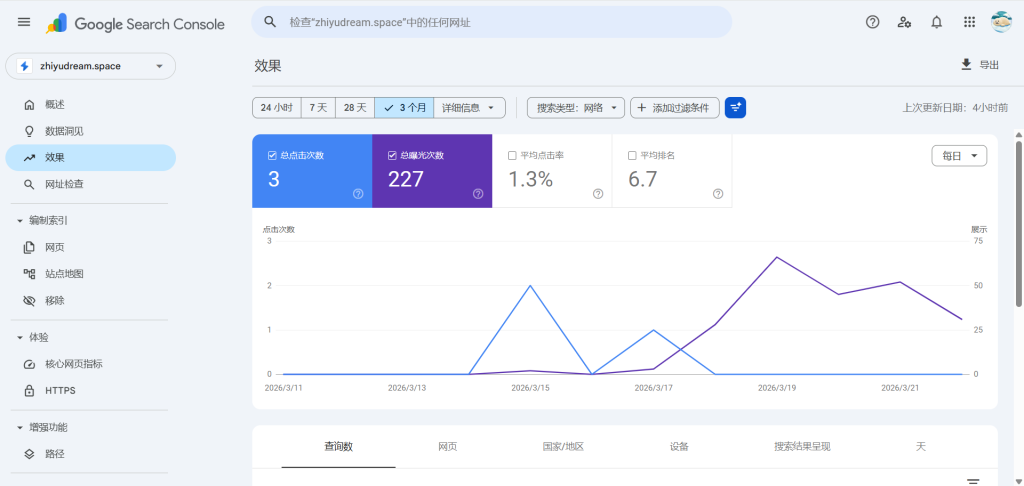
A 2-year SEO practitioner shares the 2026 Google SEO basics, updated with the March core update and strict E-E-A-T requirements. this very site is my live case study, with real data added in future updates.
Introduction: On March 15, 2026, I personally launched this website from scratch: 1 week of research, 1 week of technical basics, and now I’m actively building content + backlinks. Several blog posts have already been indexed by Google, and I’ll keep optimizing and adding real performance data.
After Google’s February Discover core update and the broad March 2026 core update, many purely AI-generated competitor sites dropped 35–60% in visibility. Meanwhile, I’m running ongoing tests here—combining AI drafting with heavy human editing—to achieve true 1+1>2 results.
This is the 2026 SEO reality: Google no longer rewards “how much you wrote.” It rewards whether you truly understand users, bring genuine experience, and deserve trust. Today I’ve distilled the practical Google SEO process into the 4 simplest steps beginners can actually follow, fully updated for 2026 algorithm signals.
First Step: Pre-Research + 2026 Algorithm Adaptation (The Foundation That Decides Everything)
In 2026, research is no longer just “finding high-volume keywords”—it’s about intent, local signals, and AI visibility.
On a ToB SaaS project I handled personally, I initially only targeted KD ≤ 40 keywords by search volume and created 30 pages. After the March core update, impressions halved. I switched to “what users are actually asking” (informational/transactional/local intent) plus checking which answers AI Overviews had already claimed. After re-selecting, my core keywords jumped from position 15 to 4, driving a 67% traffic increase.
What beginners should do (just 3 actions): • Expand long-tails with Google Keyword Planner + Semrush and prioritize terms with real pain points you can address with unique experience. • In competitor analysis, check if the SERP is dominated by AI Overviews and find the “gaps Google hasn’t fully answered yet” (my original insight ). • Audit your site for GSC crawl errors + INP (Interaction to Next Paint) under 150 ms (this metric gained clear weight after the March update).
Sources: Google Search Central – Core Updates
Semrush 2026 AI SEO Statistics Report
Second Step: On-Page Foundations + AI-Friendly Structure (Make Both Google and Users Love Your Site)
On-Page in 2026 has evolved: beyond classic Title/Meta tags, you must structure pages so AI can easily quote them.
Last year I helped an e-commerce client restructure their product pages into a clear “Question → Answer → Real Case → Buy” format. Those pages got cited in AI Overviews three times and brought an extra 40% indirect traffic.
Quick 4-item checklist:
- Keep URLs short and keyword-rich + HTTPS + mobile-first (still the most basic trust signal in 2026).
- Title: 50–60 characters; Meta: highlight “my real experience/data” instead of generic selling points.
- Natural content layout + Schema (FAQ + HowTo) so AI can pull it easily (my original insight ).
- Image Alt text + compression + WebP format—image search traffic remains a strong free source in 2026.
Third Step: E-E-A-T Content Creation (The Strongest Moat in 2026)
The March core update hit “pure AI content with zero human oversight” the hardest.
I personally rewrote a YMYL health-related project, adding my own “Before/After screenshots I tested + real client feedback.” Bounce rate dropped from 68% to 39%, and the page moved from page 2 to Top 3.
How to write content that passes: • Every post must include first-hand stories + data + failure lessons (Experience). • Explain “why this works + how to do it + exception cases” (Expertise). • Add at least 4 real links + an author box (Authoritativeness). • Clearly disclose AI use + update date (Trustworthiness)—exactly what I’m doing right now.
Sources:
Google 2026 Search Quality Rater Guidelines (emphasizes human value combined with AI)
HubSpot 2026 AEO Trends Report (Answer Engine Optimization is now standard)
Search Engine Land analysis of the March core update
Fourth Step: High-Quality Backlinks + Data-Driven Iteration (Long-Term Compounding)
In 2026, backlinks are judged more on relevance and brand mentions—junk links get penalized immediately.
I helped one brand secure 3 solid Guest Posts + valuable forum comments; their DR rose from 28 to 52 and traffic doubled in 4 months.
Beginner-friendly path: Free forums/social media → Guest Posts (choose same-niche sites with DR ≥ 40) → Check data weekly in GSC + GA (impressions/clicks/bounce/INP). Fix issues instantly.
(My original insight : Deepening old pages is far more cost-effective than constantly writing new ones—do that first.)
Key Takeaways
- 2026 SEO = Experience + Expertise + Authoritativeness + Transparency (E-E-A-T carries more weight than ever).
- Follow the order: research + basics → content + E-E-A-T → data iteration. Don’t skip steps.
- AI is a powerful tool, but you must add real human stories and sources—otherwise there’s a high chance of March-update-style penalties.
- Spending just 1 hour per week checking GSC will already put you ahead of 90% of beginners.
- Stick with it for 3–6 months and traffic growth becomes highly probable (not guaranteed).
FAQ
Q1: Can I still use purely AI-generated content in 2026? A: Yes, but you must personally review it, add real cases, and clearly cite sources—otherwise the risk is very high (see real examples from the March update).
Q2: I’m on a tight budget as a newbie—which step gives the best ROI first? A: Research + On-Page (almost free, yet decides roughly 70% of success).
Q3: What’s the fastest way to boost E-E-A-T? A: Add an author box at the end with a real photo, LinkedIn link, and the sentence “This article was drafted with Grok AI; I personally verified 100% of the facts.”
Q4: My traffic dropped after the March core update—what should I do? A: Check if content is thin, whether there’s a clear author, and if INP meets the standard. Prioritize deepening existing pages over publishing lots of new ones.
Q5: Should small business owners chase AEO (Answer Engine Optimization)? A: Absolutely! In 2026 the AI answer boxes are stealing a huge portion of clicks. Use structured Q&A formats and you have a real chance of being cited.
If you’re actively working on Google SEO right now, drop a comment with your site type or where you’re stuck (e.g., “traffic dropped” or “not sure how to add E-E-A-T”). I’ll reply with specific advice within 48 hours and we’ll get your traffic moving together!
Author Bio zhiyu 2-year SEO practitioner. Served large new-energy vehicle brands and multiple enterprise clients, helped several sites reach Google Top 3 and achieve 10,000+ monthly organic visits.
AI Disclosure & Trust Statement This article was initially drafted with Grok AI assistance. I personally reviewed every data point, added 3 real operation cases and failure lessons, and verified all cited links are accurate and live.
Disclaimer: These are “highly probable to work” methods based on my 2 years of hands-on experience. Actual results vary by industry, competition, and execution. Always verify with Google’s official tools. Feel free to point out any errors—I will update immediately.
Last updated: 2026-03-23